The Strange Old Wooden Boat

Searching for the story behind a forgotten boat frozen in a Northwest Alaska river
By Seth Kantner
Published: January 10, 2026

The old boat frozen in overflow on the Ambler River. (Seth Kantner)
KOBUK RIVER — This fall and early winter I’ve been fixated on an old wooden boat. At villages and camps along the river, there are a surprising number of them, abandoned back in the willows, decomposing. They all have histories of handmade times in our recent past, but this one was different.
At the end of September, my friend Nick Jans sent me photos of the remains of a once-fine-built boat he and Dave Griepentrog had seen on a sand bar. “Is this a Schieber boat? Found below Redstone,” he texted, referring to our mutual friend Mike Schieber, who lived for 30 years up the Ambler River and built his own boats out of spruce with hand saws and planes.
My parents, when they arrived on the upper Kobuk in 1964, had caught a ride downriver with Tommy Douglas on his homemade spruce-plank barge. Later, our first boat was a plank boat. Each spring, when we launched it, water poured in until the cracks swelled tight. My dad built boats when I was a kid, as did many dads here, and I knew right away this wasn’t one of Mike’s, and of course, I was jealous of Nick’s find.
When I received the photos, Aakatchaq and I had just made it to the coast. I was running Mike’s 25-year-old motor, one I took off my dad’s fishing boat that I gave to Mike — another boat, ahem, decomposing in the willows above Ambler. Kobuk Lake was windy, a rough crossing, and once ashore, I’d slipped on my ice-coated deck and was limping around, unloading gas jugs and gear. I was chilled from the spray, and a storm was coming, but I wished we could turn right around — 400 miles round-trip — and go retrieve what remained of that old boat. Aakatchaq very much wasn’t feeling that.
It appeared to be the gold rush era to me, or maybe from earlier explorers like Stoney, Healy or Cantwell, who could have stashed it up the Ambler or Redstone rivers. I wanted more information, but Nick couldn’t recall which bend of the Ambler it was located. They had been hooking pike and looking for animals, and now he was back in the village, busy packing to return to Florida. “Put together with square nails,” he texted. “Wonder if real old or just uncovered.”
In August and early September, again this fall, relentless rain had kept the rivers flooding, week after week. Muddy current washed out melting permafrost and cutbanks, trees and debris, and made it tough to even get ashore behind thick walls of submerged brush. Likely that boat had dropped off an eroded bank, after being hidden for a hundred years or more, and could vanish again overnight. I hinted that, but Nick was ready for me, armed with a list of things he needed to do, and impervious to my attempts to guilt him into a struggle to retrieve it. He offered six gallons of gas — $100 in Ambler — if I could find someone else to do it.
I texted Jeremy Williams in Ambler. I assumed he and other hunters had passed that boat, probably all fall, along the Ambler River. Typical Jeremy — he reminded me of his dad, and didn’t comment much, but knew exactly where it was, and even sent a map, with a red pin drop. His map showed the village airstrip. The boat was that close to town!
He’s big and strong and young, and I offered to pay him if he’d tow it down to Don Williams’, his grandpa, or even prop it up on the bank. I never heard back, which I understood to mean NO in Inupiaq. A few days later, a rumor came that caribou had showed near Onion Portage. It was obvious, now more than ever, that no one would care to hear my concerns about two-thirds of a half-rotten old white-guy boat. Probably junk, only possibly still visible, or already floated off downriver.
I tried south, sending emails in an attempt to find historians who might be interested. I got no responses there either. Had caribou showed up everywhere in Alaska? Meanwhile, in October my life wasn’t getting simpler: two big storms hit the western coast; parts of Kotzebue flooded, including my little home-shack, yard and possessions; I became a grandpa; I was studying for a wilderness medicine exam, and preparing for a presentation in Valdez, and then Aakatchaq and I left my wet hovel to fly to Anchorage to attend her art venue at AFN. Still, I kept scheming to save that old boat. I’d gotten nowhere. But … I do have that wolverine persistence.
In early November, when in Kotzebue we were reeling from two hunters perishing through the ice, Joshua Reuther, a historian from the University of Alaska Fairbanks, replied. The next morning, I built a fire, made coffee, turned off the fans drying my floor, and called him. Like me, he was intrigued. He said he couldn’t fund a recovery mission, but he might offer a $500 honorarium if I could find people willing to bring the boat to the village. I warned him it was terrible timing, with the river running ice. Even with this late fall, winter was arriving.
Excited, I called Eric Sieh, an air taxi pilot here. He offered me a very fair price to fly up the Ambler, even agreed to help chop ice, but his Cub was in Fairbanks, and his schedule was booked. The weather was cold and clear. Each day, the ocean ice was getting thicker. I’m poor at sitting around, and was jumpier than ever. I pictured the Kobuk freezing up. Mostly, I pictured what freeze-up brings: overflow. As kids, my brother and I loved skating in the fall, but we knew that when giant pans seized up the main channel, overflow backed up along the shores and sandbars. That boat could disappear under solid ice. Snow would finish it off. I felt myself finally starting to give up. I questioned, as I often do, why I pour energy in so many directions, into so many impractical endeavors. And what exactly was it about fossils, bones, ivory and human artifacts from the past that I was drawn to? And wood — what made me love wood like it was family?
Still, every few days I updated Josh and his boss Scott Shirar, mostly on my lack of progress, and concerns, which now included worrying they’d get sick of me. They were listening, though, and Josh sent a diagram of significant parts to try to save, if it came to that. I was surprised that he didn’t expect or require the whole craft.
Finally, I did what I’ve done before when I couldn’t find a way: I suddenly remembered the Hansen twins, Taylor and Gabe, hardworking young boys here, capable and up for anything. As usual, Taylor didn’t question my plan. “Yeah, I’m down. The Cub isn’t on skis, but we can put them on quick.” I told him there wasn’t a lot of snow upriver; wheels should work.
While I was packing tools, he called to say that it was his brother’s turn to fly. Gabe was on the line, too. “We should leave at first light,” he said.
“Good. Just tell me when,” I said, slow to decipher he meant legal sunrise — not until 10:34 a.m. — and we had to be back by civil sunset. Just under six hours to fly to the Ambler River, find the boat, chop or dig or whatever, and return. The other option was to stay the night, which would likely be 10 below zero. Unfazed, Gabe suggested we could also just land, wherever, at sunset, and wait for morning. I’m good at math, and old; I instantly pictured 18 hours standing around a cold airplane. I knew their 1941 Cub didn’t have a starter, or electronics. I didn’t ask if he carried a frypan to reheat his engine oil in the morning.
That evening, Aakatchaq watched me switch axes for a small hatchet, trade my light sleeping bag for a heavier one, and pile up a heap of winter gear to wear. I was joking around, as always, but serious about winnowing down my load. “There’s almost no space,” I explained. “It’s not Bering Air. Their plane is really small. It’s like sixty horsepower. Think of a chain saw, with a prop.”
Morning came crisp and cold, with a deep blue and orange horizon. I bundled up as if we were traveling by snowmobile, thrilled to get back into big country, home, and maybe finally see the boat. I put the chance of not being able to land in the back of my mind. At the plane, Gabe stuffed tools behind the single narrow passenger seat. Unfortunately, my 6-foot prybar wouldn’t fit. I’d called ahead, and Dave Griepentrog had agreed to meet us at the boat with a sled. I quickly texted him, then climbed in, horribly squeezed in my parka and bunny boots, with the insulated cowling cover stuffed between my chest and Gabe’s seatback. He propped the engine, levered himself in, and taxied toward the airstrip. We lifted off into a beautiful sunrise, heading east over the tundra at the speed of ... well, very slowly.
It seemed to take forever to cross the ice of Kobuk Lake, then the river delta, with occasional caribou trails and channels of open water. It was cold in the plane. I was glad for my winter gear. Gabe fiddled with phone jacks on his intercom, powered by his Milwaukee drill battery, but we couldn’t hear each other. I tapped on his shoulder, shouting to ask if he’d fly past my place, at Kapakavik. Half an hour later, he banked over the bluff. Below was ice, steaming slits of open water, and three wolves in front of the house, running through snow-covered tilted pans.
When the timbered ground behind Ambler dropped away, I saw Horseshoe Lake, and four-wheeler tracks on the road to the new gravel pit, but no sign of a person. The Ambler River was suddenly below us, a chaos of jumbled ice, overflow and open water that made my heart sink. Gabe was coming in low, everything happening fast, both of us peering out. We spotted a black log that could be it, frozen in glossy new overflow. I felt sad, because even if that was the boat, there didn’t appear to be a way to land. “… could land back on that road,” Gabe shouted. He came around again, touching the ice, then roaring over the dark object. He banked sharply. We were shouting to communicate, agreeing that was the boat. “... cold last night,” I heard him say. “… overflow probably thick enough.” I was surprised he trusted the overflow and gestured at the center. “That white ice, with snow ...” I shut up because he was the pilot, and we were dropping down over willows, water and jagged ice. He gave it throttle, and again, touched the snow on the center ice, and then we were rolling on slick overflow ice. It held as he angled toward shore. He opened the door while we were still moving. We jumped out. The ice had cracked but was holding. I quickly checked it with my hatchet; it was 2 or 3 inches, with water and older ice beneath. We were here!
Gabe wrapped the cowling cover on the engine. I tossed out my pickax and tools. We ran a hundred feet to the boat, circling it and admiring the woodwork, the fine lines of the stern, and a retractable keel! It was smaller than I’d thought, and one whole side was destroyed, gone. My mind was spinning, trying to decide where to start. “The UAF guys want this stern, and especially the keel. And whatever else we can salvage.” I checked the time. 12:24. We need two hours to get home. “We won’t get the whole thing out. Frig. I hate to cut it.” I glanced downriver. “I guess Dave can’t make it.” I snapped a battery in my Sawzall and started sawing. I recognized the medullary rays of oak — amazingly solid oak, smoking my blades.

The author working on chopping out the stern. (Seth Kantner)

Gabe Hansen chops through inches of overflow ice in attempt to free the stern section. (Seth Kantner)
We took turns sawing, chopping ice and scooping out slush barehanded. Finally, the stern was cut free, but something metal had frozen down in the sand. I lamented my prybar, back in Kotzebue, and my insulated rubber gloves. We abandoned the stern for a few minutes and turned to the keel. I pulled off my parka, sweating, aware that we had salvaged nothing yet. I checked the time. 1:05.
A few minutes later, we got a large section of the bottom out, then the stern. The center board with the keel seemed to weigh a couple of hundred pounds and be bolted and frozen in. We pried and heaved and chopped ice, trying not to get splashed or fall in the water.

Gabe scoops slush out to try to see down to the second layer of ice holding the stern. (Seth Kantner)

The author switches saw blades and batteries. (Seth Kantner)

Gabe pulls sections away from the water and slush. (Seth Kantner)
“Ok,” I panted. “Let’s leave it a minute.” I leaned on the keel, despising the carnage we were inflicting on this beautiful ancient relic. The whole struggle felt sacrilegious, a perfect example of what bothers me about modernity: dropping out of the sky, landing somewhere, in a terrible rush to wreck what we were trying to save. But what else could I do here? Lately, I’d been trying to keep in mind that alleged Mayan adage to “do your best, but not more than your best.” I wondered if it was the line between those two that I’d never learned.

A section of the boat with the straight keel still attached. (Seth Kantner)
I straightened up and checked the time, suddenly smiling, thinking of Dracula, and Cinderella, and other old fables about having to get home before sunrise or sunset. Actually, being in a rush was as old as this river.
Finally, we got the keel loose. Gabe took the hatchet and walked out to check the center ice while I slid sections of the boat to shore and hauled what I could up on the bank. He came back and helped me stand the stern and keel in the willows. “Center ice is good,” he said. He pointed to one of the side planks. “See that cork?”
Sure enough, someone had stuffed a big cork in a knothole, to keep water out, maybe 130 years ago, and there it was still. We laughed, admiring the simplicity and durability, then hurried to haul tools and a few small oak ribs to his plane. We shouldered the plane along the shore, to get momentum, then swung the nose out and raced it across the thin ice to the snow.
He propped it and taxied down the middle ice. It was 2:11 p.m., and I circled the boat remains protruding from the water, took a last photo, dreaming of returning to chop out the rest, then ran out to where he was turning the Cub to point upriver.

A cork had been used to plug a round knot hole. (Seth Kantner)
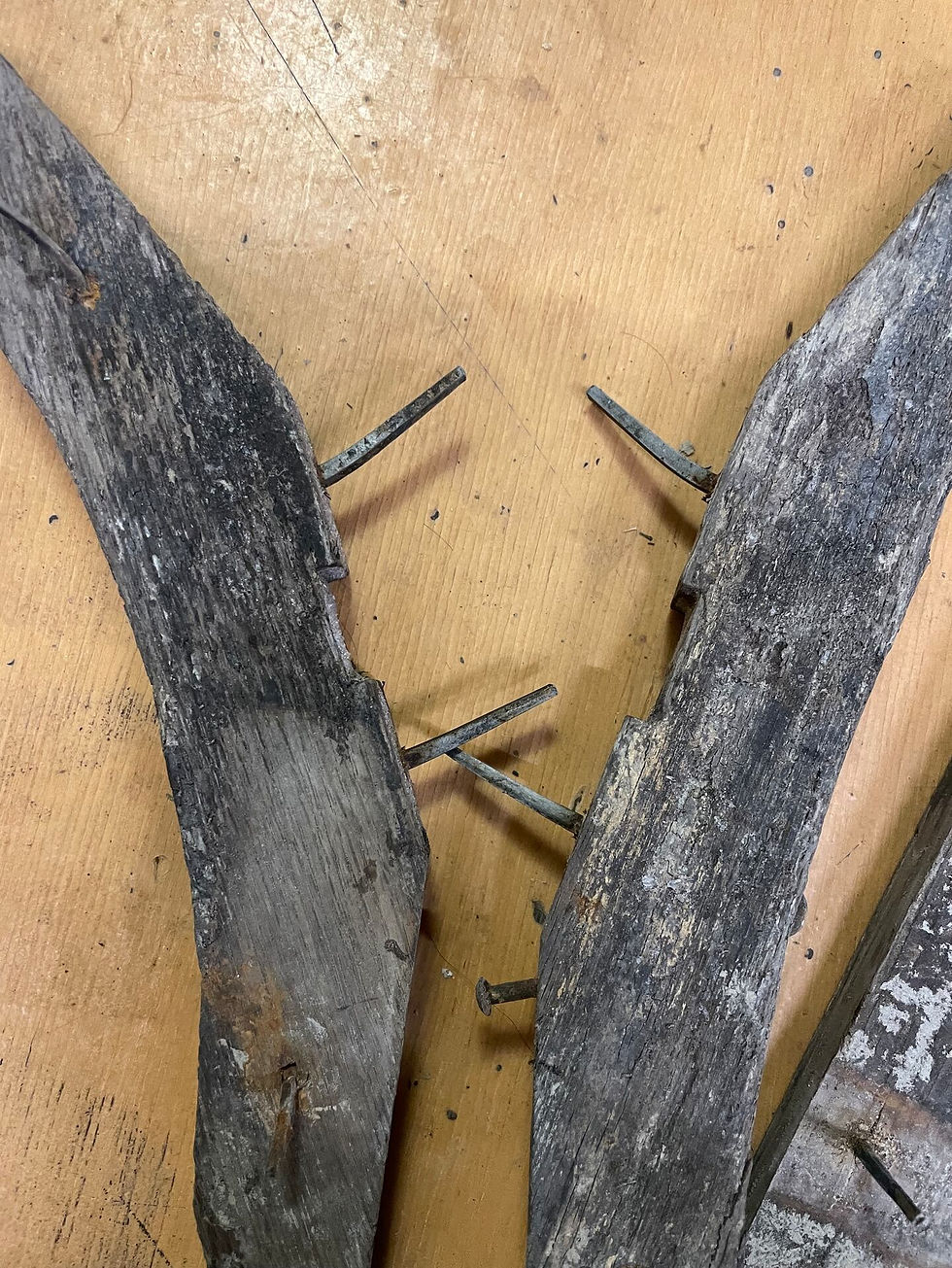
Close-up ribs with square nails in near-perfect condition. (Seth Kantner)
The takeoff was exciting, the little plane slow to gather speed, the smooth ice ending at a scary jumble, but by then we were airborne. The flight home was cold and long, with tundra and river and sand dunes glowing in winter light, a few caribou down there, and the huge land stretching away into broad valleys and mountains and more mountains, pretty much as it had been back when that boat first journeyed into this country.

As the land freezes, open water steams on the Kobuk River. (Seth Kantner)
Eventually, after more texts and emails, I delivered sample oak ribs with square nails to Scott at UAF, and weeks later, Dave sledded pieces to the Ambler airstrip. All that remained was the heavy keel. Desperate, I called Andrea Kelly. Like the Hansen boys, she’s up for anything. I knew she was recovering from a broken collarbone and ribs — she didn’t tell me she was freshly bunged up, now with a broken neck — but she and Austin Rue-Roberts headed straight upriver in the dark to bring the keel in for me. Ryan Air delivered the sections to Kotzebue, and Northern Air Cargo transported them to Fairbanks.
Last week, I got a phone call from Steve Lanford, a historic archaeologist. He didn’t have the boat’s main parts yet, but said the cut nails were indicative of it being from the gold rush era. He relayed fascinating information about whaling longboats in the 1800s, although he said his real expertise was on century-old tin cans. He was fun to talk with, and I look forward to our next chat.
Until then, tonight, I’m no closer to knowing the story of the people of this old boat. Tonight, it seems as if none of this ever happened. Maybe that’s the way most of life is, buried by time — except when I pass my workbench, and lying there in the tangle of iPhone cords, tools and junk is a piece of finely chiseled, aged gray wooden rib, with perfect square nails protruding. And then, still, a nearly invisible thread to the past and the mystery of who propelled this craft along these rivers remains.


Comments